
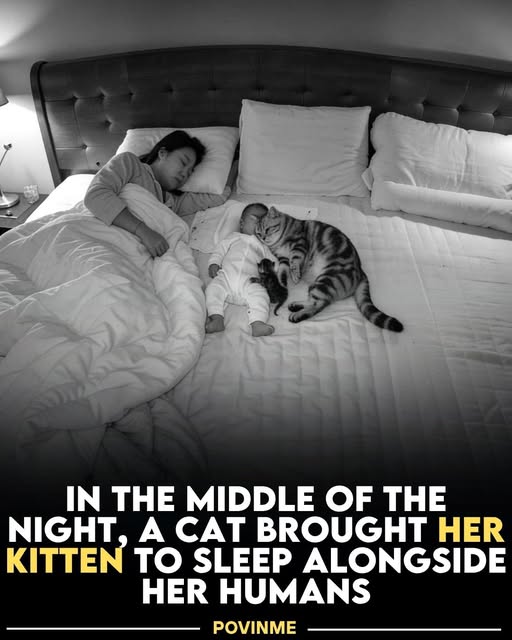
At 2:17 in the morning, the house was silent except for the soft hum of the ceiling fan and the distant sound of rain tapping against the windows.
Emily Carter, a veterinary assistant from Oregon, barely stirred when she felt a gentle pressure near her feet. Half asleep, she assumed it was Luna — the rescued gray tabby cat who had lived with her family for almost three years.
Luna often slept at the edge of the bed.
But this night was different.
When Emily slowly opened her eyes, she saw Luna carefully climbing onto the mattress, moving with unusual caution. In her mouth was something tiny, fragile, and alive.
A kitten.
The little kitten’s eyes were barely open. Its ears still folded close to its head. Luna stepped carefully across the blanket, then lowered the kitten directly beside Emily and her husband Daniel before curling her body protectively around the baby.
Emily froze.
“She looked at me like she was asking permission,” Emily later recalled. “Not scared. Not nervous. Just trusting.”
For several minutes, nobody moved.
The kitten slept peacefully between Luna’s paws while the mother cat rested her chin on the blanket, completely relaxed. It was one of those quiet moments pet owners never forget — a moment that feels almost too emotional to explain.
According to American feline behavior specialists, scenes like this reveal something deeply important about how cats form emotional bonds with humans.
Many people still believe cats are distant or independent creatures that simply tolerate people. But cat experts across the United States say that assumption misses the emotional complexity of feline behavior entirely.
Dr. Mikel Delgado, a well-known cat behavior consultant in California, has often explained that cats choose safe social environments very carefully. When a mother cat intentionally places her kittens near humans, it can indicate extraordinary levels of trust.
And Luna’s story would soon prove exactly that.
A Rescue Cat Who Never Fully Trusted the World
Three years earlier, Luna had been discovered behind a grocery store dumpster during a winter storm.
She was thin, soaked from rain, and terrified of people.
Emily remembered that Luna would hiss anytime someone came too close. Even the sound of footsteps caused her to hide.
“It took months before she would eat in front of us,” Emily said.
Unlike dogs, many traumatized cats recover slowly because they depend heavily on environmental security. Felines are territorial animals. Safety matters more to them than social excitement.
That is why trust from a cat is profoundly meaningful.
Over time, Luna began sleeping near Emily’s feet. Then she started greeting Daniel at the door after work. Eventually she developed a nightly routine of sitting between the couple on the couch while they watched television.
“She became part of our emotional rhythm,” Daniel said. “You could feel when she was happy. You could feel when she was anxious.”
Then, earlier that spring, the family discovered Luna was pregnant.
The Protective Instinct of Mother Cats
Feline maternal behavior is remarkably sophisticated.
According to experts in feline medicine, mother cats constantly evaluate environmental risks after giving birth. They search for warmth, quiet, darkness, and protection from possible threats.
Most mother cats relocate kittens multiple times during the first weeks of life.
This behavior comes from survival instinct.
In the wild, repeatedly moving kittens helps reduce predator detection and improves survival rates. Even domestic indoor cats still carry those instincts.
What surprised Emily was not that Luna moved her kitten.
It was where she moved the kitten.
Directly into bed with the humans.
Dr. Hannah Shaw, known nationally for neonatal kitten rescue education in the United States, has explained that mother cats often choose locations associated with maximum security. If humans consistently provide food, warmth, calmness, and protection, a cat may eventually identify them as part of her safe social group.
That appears to be exactly what happened with Luna.
“She didn’t bring the kitten to a closet,” Emily explained. “She brought the baby to us.”
The Midnight Walk to Safety
The family later reviewed footage from their indoor pet camera.
At around 2:11 a.m., Luna entered the closet where her kittens had been sleeping. She gently picked up the smallest kitten from the nesting area.
Then she paused.
Instead of settling into another hidden location, she walked directly through the hallway toward the master bedroom.
Experts say this detail matters.
Cats are highly intentional movers. A mother cat carrying a newborn kitten is extremely vulnerable during transport. She will normally avoid unnecessary exposure.
Yet Luna bypassed several secluded hiding places.
She chose the humans.
“She walked slowly and confidently,” Daniel said after watching the footage. “Like she had already made up her mind.”
Once she reached the bed, Luna carefully climbed up without waking the couple. Then she placed the kitten beside Emily before curling around the baby protectively.
For the next four hours, neither mother nor kitten moved.
Why Cats Sleep Near Humans They Trust
Feline sleep behavior reveals emotional security more than many owners realize.
Cats are biologically vulnerable while sleeping. Even though domestic cats retain predator instincts, deep sleep requires an environment that feels safe enough to lower defensive alertness.
American cat behaviorists often note several trust signals:
- Sleeping with exposed belly
- Slow blinking
- Grooming near humans
- Bringing kittens or toys to humans
- Choosing physical closeness during rest
Luna displayed nearly all of them.
By bringing her kitten into the family bed, she was demonstrating not only trust in the humans, but also confidence that the environment itself was secure.
“This is advanced social bonding behavior,” one feline rescue specialist explained online after hearing Luna’s story. “Cats do not place vulnerable kittens near people they fear.”
The emotional impact on the family was immediate.
Emily admitted she cried quietly that morning.
“There was something so pure about it,” she said. “She trusted us with her baby.”
The Smallest Kitten Needed Extra Care
Over the next several days, the family noticed that the tiny kitten Luna carried into the bed was weaker than the others.
He struggled slightly during feeding and often separated from the litter.
Veterinarians explain that mother cats sometimes give extra attention to smaller kittens, especially if they sense vulnerability. In some cases, a mother cat may even seek additional warmth or safety resources for weaker newborns.
Luna repeatedly carried that same kitten back into the bedroom every night.
Always beside the humans.
“She never brought the larger kittens,” Daniel noticed. “Only him.”
Emily named the kitten Oliver.
Each night became a ritual.
Luna would nurse the litter, wait until the house became quiet, then gently carry Oliver into bed before settling near Emily’s side.
Sometimes Oliver slept pressed against Luna’s chest.
Other times he slept stretched across the blanket between the humans.
The family adjusted carefully, terrified of disturbing the tiny routine.
What Cat Experts Say About Emotional Intelligence in Cats
For decades, popular culture underestimated feline emotional intelligence.
Dogs were viewed as affectionate family companions, while cats were often stereotyped as detached or indifferent.
Modern animal behavior science tells a very different story.
Research increasingly shows that cats form attachment patterns with humans similar to those seen in children and dogs. Cats recognize emotional tone, routines, facial expressions, and environmental stability.
Many feline experts in the United States argue that cats simply communicate differently.
Their affection is quieter.
Subtle.
Intentional.
A cat choosing proximity is meaningful because cats naturally value personal control over space. When they voluntarily seek closeness, it reflects emotional confidence.
Luna’s nightly behavior became an example of that trust in its purest form.
“She wasn’t just sharing space,” Emily explained. “She was sharing responsibility.”
The Family Began Sleeping Differently
Soon the family adjusted their entire nighttime routine around Luna and Oliver.
Daniel stopped moving abruptly during sleep.
Emily placed soft blankets along one side of the bed to create a secure nesting area.
A small nightlight remained on every evening.
“It felt like we had a newborn baby in the room,” Daniel laughed.
Friends initially warned the couple against allowing cats in the bed with newborn kittens, but their veterinarian reassured them that Luna’s behavior appeared calm, organized, and deeply maternal.
The cat never displayed aggression.
Never panic.
Never signs of stress.
Instead, Luna became visibly more relaxed while sleeping beside the family.
“She purred constantly,” Emily said. “The loudest purring we had ever heard from her.”
The Internet Falls in Love with Luna
Weeks later, Emily shared a short clip online showing Luna carrying Oliver onto the bed.
The video exploded across social media.
Millions of viewers responded emotionally to the scene.
Comments poured in from cat owners around the world:
“She chose you as family.”
“That cat trusts you with her whole heart.”
“Cats always know where safety lives.”
Veterinary professionals also commented on the remarkable maternal behavior.
Some explained that mother cats sometimes create “shared nesting” situations when they feel deeply secure within human households.
Others noted how carefully Luna monitored Oliver’s condition.
One emergency veterinarian wrote:
“Cats are far more emotionally intelligent than people realize. This mother identified her humans as protectors.”
The story resonated because it reflected something many pet owners experience but struggle to describe — the moment an animal truly accepts humans as part of its emotional world.
Oliver Begins to Grow Stronger
By six weeks old, Oliver transformed dramatically.
The tiny fragile kitten developed into an energetic orange-and-white troublemaker who climbed curtains, chased socks, and attacked shoelaces with fearless determination.
Yet one thing never changed.
Every night, Oliver still slept beside the humans.
Even after he no longer needed maternal supervision, he continued curling near Emily’s shoulder while Luna rested nearby.
Experts say early environmental bonding often influences adult feline attachment patterns.
Because Oliver associated human presence with warmth and safety from birth, he naturally viewed the family bed as secure territory.
“He grew up believing we were part of the nest,” Emily said.
Why Stories Like This Matter
In an era dominated by fast-moving digital content, stories like Luna’s affect people because they reconnect us with quiet emotional truths.
Animals communicate care without language.
No performance.
No social expectation.
Only instinct, trust, and presence.
Cat experts frequently emphasize that feline affection is not transactional. Cats do not express attachment in exaggerated ways simply to please humans.
Their trust must be earned through consistency and safety.
That makes moments like Luna carrying her kitten into bed extraordinarily powerful.
The action was voluntary.
Intentional.
Emotional.
“She gave us the most important thing she had,” Daniel said softly. “Her baby.”
Understanding the Maternal Bond in Cats
Mother cats form intense bonds with newborn kittens during the earliest weeks of life.
Feline maternal hormones increase grooming behavior, nursing frequency, protective instincts, and environmental awareness.
During this stage, the mother constantly evaluates danger levels.
Experts say stressed mother cats usually isolate more aggressively. They hide kittens, relocate frequently, or become defensive around humans.
Luna displayed the opposite pattern.
Her calm behavior strongly suggested emotional confidence in the environment and the people within it.
“She considered the humans part of the protection system,” a feline behavioral consultant explained in response to the story.
That distinction matters because cats are selective social animals.
They do not easily surrender vulnerability.
The Quiet Lessons Cats Teach Humans
Emily later reflected on how Luna changed the family emotionally.
“She taught us patience,” she said. “You can’t force trust from a cat. You earn it slowly.”
Animal experts agree.
Cats respond strongly to consistency, tone, predictability, and emotional atmosphere. Loud environments, sudden handling, and forced interaction often damage trust-building.
But calm routines strengthen it.
Over time, Luna learned that the bedroom represented warmth, calmness, and emotional safety.
So when she needed the safest place for her vulnerable kitten, she followed instinct directly toward the humans she trusted most.
It was not random behavior.
It was a decision shaped by experience.
The Nightly Tradition Continues
More than a year later, Luna and Oliver still sleep in the family bed almost every night.
Oliver usually arrives first, launching dramatically across the blanket before circling several times near Emily’s pillow.
Luna follows more slowly.
She still settles beside the humans with the same calm expression she wore the first night she carried Oliver into the room.
Sometimes Emily wakes during the night and sees both cats sleeping peacefully under the soft glow of the nightlight.
“It reminds me how lucky we are,” she said.
Not lucky because they own pets.
Lucky because they were trusted.
What the Story Reveals About Human-Animal Relationships
Animal behavior specialists increasingly argue that relationships between humans and companion animals involve emotional reciprocity far deeper than previously understood.
Cats especially challenge traditional assumptions about affection.
Unlike highly approval-driven species, cats choose closeness selectively. Their trust develops through observation and environmental reliability.
That is why stories like Luna’s resonate emotionally across cultures.
People recognize authenticity when they see it.
A mother cat carrying her vulnerable kitten into bed beside sleeping humans represents something profoundly intimate:
Trust overcoming instinctive caution.
Safety overcoming fear.
Family extending beyond species.
The Final Midnight Memory
Emily still remembers the exact feeling of waking up that night.
The room was dark.
Rain tapped softly against the windows.
And beside her lay a tiny sleeping kitten wrapped safely within the paws of a rescued cat who once feared every human she saw.
“It felt like she was saying, ‘Help me protect him,’” Emily whispered.
Luna never spoke a word.
She did not need to.
Her decision said everything.
In the middle of the night, when instinct mattered most, the mother cat chose the place she trusted above all others:
Right beside the humans she loved.